
Car maintenance
How to jump-start a car safely, step by step
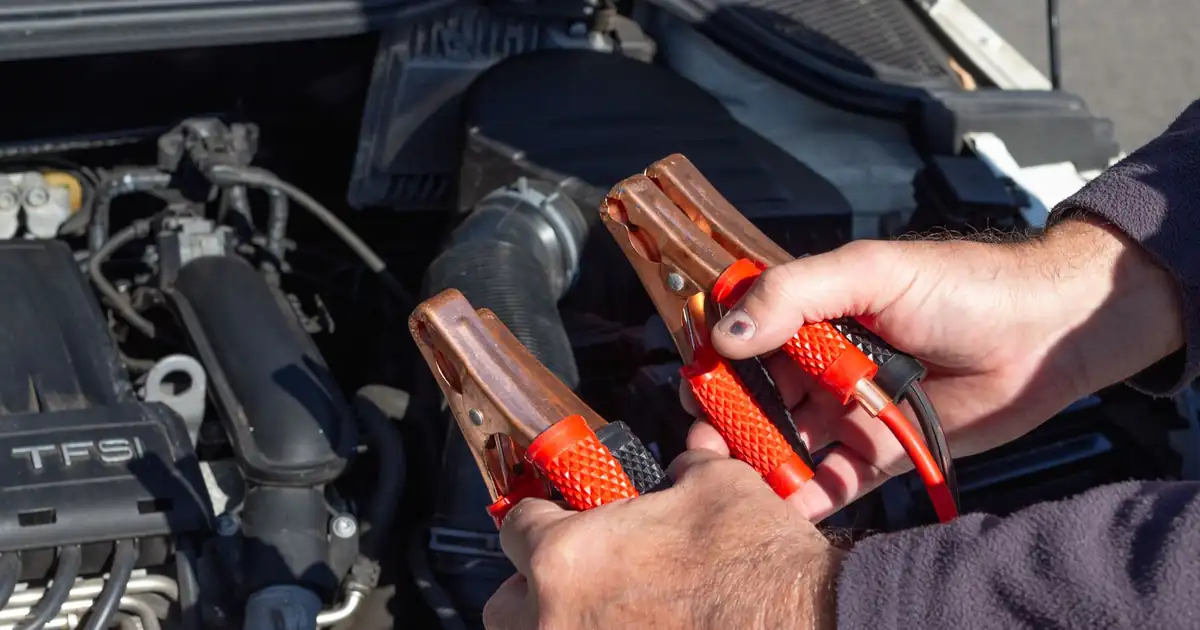
How do you jump-start a car safely?
Park the working car close without touching, turn both engines off, then connect red to the dead battery’s positive post, red to the good battery’s positive, black to the good battery’s negative, and black to bare metal on the dead car’s engine. Run the donor for a few minutes, start the dead car, and remove the cables in reverse.
What you need to jump-start a car
The job needs only a few items, and keeping them in the trunk year-round means you are never waiting on a stranger who happens to have cables. The single most important item is a decent set of jumper cables, because thin, cheap cables are the most common reason a correctly done jump still fails.
Cable thickness is measured in gauge, and a lower number means a thicker wire. Thicker wire carries more current with less loss, so it starts the car faster and runs cooler. For most cars and small SUVs, 4 to 6 gauge is a good choice, and a length of 12 to 20 feet lets you reach a battery even when the cars cannot park nose to nose.
Jump-start kit
- Jumper cables, 4 to 6 gauge, 12 to 20 feet long, with clean clamps and no cracked insulation
- A second vehicle with a healthy battery of the same voltage, which is 12 volts on virtually every modern car, or a charged portable jump starter
- Safety glasses and gloves, because batteries can vent acid and hydrogen gas
- A flashlight, since dead batteries rarely pick a convenient time of day
- Your owner’s manual, which shows where the battery or the remote jump-start posts are located
- A rag or wire brush for corroded terminals that will not make a clean connection
Safety checks before you connect anything
A car battery is low voltage, so the shock risk is small, but it holds a great deal of energy and a charging battery gives off hydrogen gas. The risks are a spark that ignites that gas, a short circuit that welds a clamp or melts a cable, and a voltage spike that damages a car’s electronics. Each of the checks below removes one of those risks.
Do not jump-start if any of these apply
- The battery case is cracked, bulging, leaking, or visibly frozen, which can make it rupture under charge
- The cables are frayed, the clamps are loose, or the insulation is split
- Anyone is smoking, or there is an open flame or fuel leak nearby
- The two vehicles are touching, which can create a ground path you did not intend
- The owner’s manual for either car says not to give or receive a jump, as some hybrids and electric vehicles do
Make sure the battery is the problem
A jump-start only helps when the battery is too weak to turn the starter. Before you pull out cables, spend thirty seconds reading what the car is telling you. A rapid clicking from under the hood, an engine that turns over slowly and then stops, a dashboard that flickers, and headlights that look yellow and dim are all signs of a discharged battery.
If the headlights are bright, the dash lights up normally, and you hear nothing at all when you turn the key or press the start button, the battery is probably fine and a jump will not change anything. That pattern points to the starter, a failed ignition switch, a security system that does not recognize the key, or a shift lever not fully in Park.
Cold weather makes the battery the most likely suspect. A lead-acid battery loses a large share of its cranking power as the temperature drops, while a cold engine with thick oil needs more power to turn. That combination is why so many batteries on Long Island give up on the first hard freeze of the winter.
How to position both cars
Park the working car close enough that the cables reach both batteries without being pulled tight, ideally nose to nose or side by side. The cars must not touch. Put both in Park, or in neutral for a manual transmission, set both parking brakes, and switch both ignitions fully off.
Turn off headlights, the radio, the climate control, and anything plugged into a power outlet in both vehicles. Electrical loads that come on with the ignition compete with the starter for current, and switching them off also protects them from the small voltage spike that can happen when the cables are removed. If you can, lower the driver’s window of the dead car before you start, since some cars lock their doors when power returns and the key fob may be sitting on the seat.
Open both hoods and find the batteries. On many newer vehicles the battery sits in the trunk, under the rear seat, or under the floor, and the manufacturer puts a remote positive jump post and a ground point under the hood. When those posts exist, use them rather than reaching for the battery itself.
The correct order to connect jumper cables
The order matters because it controls where the final spark happens. The first three clamps make no circuit. The fourth clamp completes it, and completing a circuit can spark. By making that last connection on bare metal away from the dead battery, any spark happens away from the hydrogen gas that a weak battery gives off.
Identify the terminals before you start. The positive post is marked with a plus sign and usually has a red cover or a red cable. The negative post is marked with a minus sign and usually has a black cable. Keep the two clamps on each end of the cable apart from each other the entire time. If a terminal is crusted with white or green corrosion, wiggle the clamp jaws until they bite through to bare metal.
An easy way to remember the order: red to dead, red to good, black to good, black to ground. To take them off, work backward, black first and red last.
Connect in this order
- Red clamp to the positive (+) terminal of the dead battery
- The other red clamp to the positive (+) terminal of the good battery
- Black clamp to the negative (−) terminal of the good battery
- The last black clamp to a clean, unpainted metal part of the dead car’s engine block or frame, at least a foot away from the battery and away from fuel lines and moving belts
Starting the cars and how long to wait
Check that every cable is clear of fans, belts, and pulleys. Start the working car and let it run for two to three minutes. That gives its alternator time to push some charge into the dead battery, so the dead car’s starter is not relying entirely on the donor’s battery through a long cable.
Now try to start the car with the dead battery. If it cranks and starts, leave it running. If it cranks slowly but does not catch, wait another five minutes with the donor running and try again, holding the donor’s engine at a slightly raised idle if you have a helper. Avoid cranking for more than about ten seconds at a time, and give the starter a minute to cool between attempts.
If the car still will not start after ten to fifteen minutes on the cables, stop. Either the battery is too far gone to take a charge, the cables are not making good contact, or the problem is not the battery at all.
How to disconnect jumper cables
Once the car is running, remove the cables in the exact reverse of the order they went on. Do not let any clamp touch another clamp or the car’s body while the other end is still connected, because that is the moment a careless short is most likely.
Disconnect in this order
- Black clamp from the ground point on the car that was dead
- Black clamp from the negative terminal of the good battery
- Red clamp from the positive terminal of the good battery
- Red clamp from the positive terminal of the battery that was dead
What to do after the car starts
Do not shut the engine off. A battery that has just been jumped has only enough charge to start the car once, and sometimes not even that. Drive for at least 20 to 30 minutes, ideally with some steady road speed, so the alternator can put meaningful charge back in. Idling in a driveway charges far more slowly because the alternator turns slowly at idle.
Keep electrical loads modest during that drive. Rear defrosters, heated seats, and high fan speeds all take current that would otherwise go into the battery. Stop-and-go traffic charges far less than steady driving, so a short crawl through town may not be enough.
A drive only partly recharges a deeply drained battery. A plug-in battery charger, left on for several hours, restores it fully and is easier on the battery. If the battery is more than three years old, or the car needed a jump without an obvious cause such as a light left on, have the battery and charging system tested. The test takes a few minutes and tells you whether the battery can still hold a charge and whether the alternator is doing its job.
How to jump-start a car without another car
A portable jump starter, sometimes called a jump pack or booster pack, is a lithium or lead-acid battery with built-in clamps. It does the same job as a donor car, and many units include protection against reversed clamps. Check that the pack is charged, connect the red clamp to the positive terminal and the black clamp to bare metal on the engine, switch the pack on, and wait for its ready light before you start the car. Disconnect black first, then red. A jump pack only works if you keep it charged, so top it up every few months.
A car with a manual transmission can also be push-started, or bump-started, without any battery help. With the ignition on, the clutch pressed, and the car in second gear, roll the car to walking pace downhill or with helpers pushing, then release the clutch quickly. The wheels turn the engine and it fires. This does not work on an automatic transmission and should not be tried on a hybrid. Major breakdown services advise against push-starting at all, because of the risk to the people pushing and to the catalytic converter if the engine misfires, so treat it as a last resort.
Why a battery keeps dying, and when to replace it
Most car batteries last three to five years in this climate. Heat in summer speeds up internal corrosion, and cold in winter exposes whatever capacity has been lost. A battery near the end of that range that needed a jump is usually telling you it is time, even if it seems fine for a few days afterward.
Younger batteries that keep going flat usually have a reason. Short trips that never let the alternator catch up, a light left on, corroded or loose terminals, a failing alternator, or a module that stays awake after the car is locked can all drain a good battery. A test that measures cranking capacity and the charging output separates a worn battery from a charging problem in a few minutes.
How to avoid needing a jump
Most dead batteries give a warning first. Catching those signs early turns a roadside jump into a scheduled battery swap.
Warning signs and habits that keep a battery healthy
- Watch for a slow or labored crank, a clicking sound at startup, dim lights at idle, or a battery warning light on the dash
- Have the battery tested every fall once it is three years old, before the first cold snap does it for you
- Drive at least 20 minutes at a stretch regularly; a car used only for short errands never fully recharges
- For a car that sits for weeks, use a battery maintainer, or charge it every couple of months
- Keep the terminals clean and tight, since corrosion blocks both starting current and charging
- Check that interior, trunk, and glovebox lights switch off when the car is locked
If the car still will not start
A failed jump is information. What you hear and see while trying narrows the cause considerably, and it often tells you whether the car needs a tow or just a new battery.
| What happens | Most likely cause | Next step |
|---|---|---|
| Rapid clicking even with cables on | Poor clamp contact or a very deeply discharged battery | Clean the terminals, re-seat the clamps, wait longer with the donor running |
| One loud click, then nothing | Starter motor or starter relay | Have the starter circuit tested; a jump will not help |
| Cranks normally but will not fire | Fuel, ignition, or immobilizer, not the battery | Check for a security light on the dash; have it diagnosed |
| Starts, then dies when cables come off | Alternator is not charging | Do not drive far; have the charging system tested |
| Starts fine but is dead again the next morning | Battery cannot hold a charge or something is draining it | Battery load test and a parasitic draw test |
Hybrids, electric cars, and start-stop vehicles
Hybrids and electric vehicles still have a conventional 12-volt battery that powers the computers, locks, and the system that wakes up the high-voltage battery. When that 12-volt battery dies, the car will not turn on, and it can usually be jumped through dedicated posts under the hood. The high-voltage battery is never jumped.
Many manufacturers advise against using a hybrid or electric vehicle as the donor car, because the 12-volt system on those cars is not designed to supply the current a conventional starter draws. Check the owner’s manual before offering a jump with one.
Cars with automatic engine start-stop use an absorbed glass mat or enhanced flooded battery and a battery sensor on the negative cable. Jump them through the remote posts and connect the final ground clamp to the designated ground point rather than the negative battery terminal, so the sensor is not bypassed.
How a jump-start actually works
Three parts start your car and keep it running. The battery stores electrical energy. The starter motor draws a burst of current from it, often well over a hundred amps, to turn the engine over. Once the engine runs, the alternator takes over, powering the car and recharging the battery.
Jumper cables simply borrow that burst of current from a healthy battery. They have four insulated clamps: the two red clamps join the positive terminals, and the two black clamps join the negative side, one on the good battery and one on bare metal of the dead car, which the car uses as its ground. With the donor running, its alternator and battery together feed the dead car’s starter until the engine fires and its own alternator takes over.
That is also why a jump does not fix anything. If the battery is worn out, or the alternator is not charging, the car will be back to a no-start soon after the cables come off.
Useful answers
More questions about car maintenance
What order do you connect jumper cables?
Red to the dead battery’s positive, red to the good battery’s positive, black to the good battery’s negative, then black to unpainted metal on the dead car’s engine. Remove them in the reverse order.
How long should you leave jumper cables connected?
Let the working car run for two to three minutes before trying to start the dead car. If it does not start, wait about five more minutes and try again. More than fifteen minutes without success means a jump is not going to fix it.
How long should I drive after a jump-start?
At least 20 to 30 minutes, preferably at road speed rather than idling, so the alternator can recharge the battery enough to restart the car.
Which jumper cable do you take off first?
The black clamp on the ground point of the car that was dead. Then remove black from the good battery, red from the good battery, and finally red from the battery that was dead.
Can you jump-start a car in the rain?
Yes. Twelve volts does not create a meaningful shock risk through wet skin. Keep the clamps from touching each other, wipe standing water off the battery top, and take the same care with the connection order.
What do the red and black jumper cables mean?
Red is positive and connects to the positive (+) terminals. Black is negative and connects to the good battery’s negative terminal and to bare metal on the dead car, which serves as its ground.
Can a hybrid or electric car jump-start another car?
Often not. Many manufacturers say not to use a hybrid or electric vehicle as the donor because its 12-volt system is not built to supply a starter motor. Check the owner’s manual first.
Can a jump-start damage my car?
It can if the clamps are reversed, if the clamps touch each other while connected, or if the cables are removed with heavy electrical loads switched on. Following the connection order and switching off accessories avoids nearly all of the risk.
Can you jump-start a car with a bad alternator?
Usually yes, but the car will run only on what is left in the battery and will die again, often within a short drive. A battery warning light on the dash after a jump is a strong sign the alternator is the real problem.
Next step
Where this leads next
Each link below answers the question this page usually raises next.